
HE CAME TO BUILD
The hardware merchant who built a bank forty-eight days before Seattle burned.

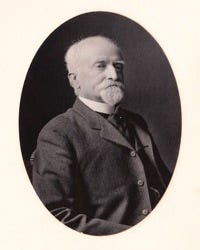
There was no railroad to Seattle in December 1882. To get there, you came by boat — from Tacoma, usually, on the last leg of a journey that had taken Martin Dickerson Ballard through Indiana, Iowa, Nebraska, and Oregon before it delivered him to a city that was still figuring out what it wanted to be. He was fifty years old. He had a wife, two children, and a partner from Albany named Edward Sox who had arrived two weeks ahead of him to scout the ground. They had planned this in Oregon. They were not improvising.
The store opened on 2 February 1883¹ on the east side of Front Street, sixty feet north of James, opposite Pioneer Square. Roy P. Ballard, nine years old, remembered helping hand up the first boxes of hardware to be put on the shelves.² It was a small operation by what it would become — thirty by sixty feet in a building owned by Henry Yesler, stocked with hardware, agricultural implements, wagons, ox equipment, and fishing nets. The city around it had perhaps ten thousand people. The nearest major hardware house was in Portland.
Martin had done this before. He had opened a hardware store in Washington, Iowa after returning east in 1867. He had moved it to Lincoln, Nebraska, where he and his brother Dayton ran Ballard Brothers until 1877. He understood the trade’s rhythms — what sold, what didn’t, how to extend credit, when to collect. What he was building in Seattle was not an experiment. It was an execution.
Three Tracks
Within two years the store had outgrown Yesler’s building. On 18 March 1885, Ballard & Sox incorporated as the Seattle Hardware Company,³ with Martin as president, Anson Burwell as secretary, and Edward Sox as treasurer. They moved to a larger brick building at 625 Front Street. The company operated as a jobber — buying from manufacturers, supplying the full range of what the region’s industries demanded: explosives, fishing nets, logging equipment, builders’ supplies, the complete inventory of a city that was simultaneously clearing timber, building wharves, and laying streets. By October 1888 it was generating $1,500 a day in revenue⁴ — the first hardware house of consequence north of Portland.
But hardware was only one track.
Martin had been watching Seattle’s real estate from the moment he arrived. The city was growing faster than its boundaries. He had seen this kind of future before, years earlier, when he traveled Puget Sound by canoe selling flour from Albany and imagining what the sawmill towns might become. By 1884 he had filed the Lake Union Addition plat,⁵ he and Harriet jointly, less than eighteen months after opening the store. He was not waiting to see how the hardware business turned out. He was already running parallel.
The third track opened in March 1888, when Martin joined the founding incorporators of the Home Fire Insurance Company of Seattle. By July, when the company held its first stockholder meeting, his name appeared alongside a familiar one — Ezra Meeker’s.⁶ The two men had grown up two years apart in Wayne Township, Marion County, Indiana — community neighbors whose connection went back to the Oregon Trail of 1852. It was Oliver Meeker, Ezra’s older brother and Martin’s neighbor and friend, who had invited Martin to spend the night and read a letter from Ezra describing the wonders of Oregon. Oliver and Martin had stayed awake until five in the morning planning their adventure, and by dawn had announced they were leaving with the emigrant train then being made up.⁷ By 1890 the connection between Martin and Ezra had warmed into something more visible: on a Thursday afternoon in June, Martin and Harriet joined the Meekers at their home in Puyallup, and the Tacoma Daily Ledger noted the occasion in passing — “M. D. Ballard and E. Meeker came over the plains together, and they are greatly enjoying this reunion after forty years.”⁸ Thirty-eight years after leaving Indiana, they were still finding their way back to each other.
By October 1888 Martin was president of the Seattle Hardware Company, a real estate developer filing plats with the county auditor, and a founding member of Seattle’s newest bank. Three tracks, all live, all feeding each other.
On 19 April 1889 — a Thursday — the Bank of Commerce filed its articles of incorporation in Seattle. M.D. Ballard was listed among the founding incorporators.⁹ He had been in the city six and a half years. The pivot to banking was complete before anything happened to make it necessary.
Forty-eight days later, Seattle burned.
Forty-Eight Days
The fire started on the afternoon of 6 June 1889 in a cabinet shop at the corner of Front and Madison, and by the time it was done it had consumed twenty-five city blocks. The Seattle Hardware Company lost $75,000 in inventory. Insurance covered $25,000 of it.¹⁰
The arithmetic was brutal. Fifty thousand dollars uninsured, in a single afternoon, in a city that was suddenly a field of ash and framing timber. The St. Louis Globe-Democrat ran the losses list on 8 June: “Seattle Hardware Company, $75,000; partly insured.” The national press noted it. Seattle noted everything.
What the loss list could not show was what Martin already had. The real estate hadn’t burned. The bank hadn’t burned — it had been incorporated forty-eight days earlier and had not yet accumulated the kind of inventory that fire could touch. The company itself survived as an institution even as its stock became ash; it reopened in temporary quarters within weeks, first in a horse barn at Second and Pike, then in a building on West Street.
He did not panic. He did not rebuild in place. He had been in tighter spots — a pack train stolen overnight outside Walla Walla, a gold mine that yielded nothing, an Indian war. He was fifty-six years old and he had been rolling with the country’s punches for thirty-five years. The fire was the largest single financial loss of his career, and it arrived at the precise moment he had already decided to move on from the thing it destroyed.
By October 1889 he had taken his wife and daughter to California for the winter.
The Oldest Stockholder
Seattle rebuilt without him that season. He spent the winter in California while the city he had helped build hammered itself back together, and when he returned in March 1890 the transition he had been engineering was waiting to be completed. On 8 April the Seattle Hardware Company held its annual meeting.¹¹ The officer list confirmed what the previous months had been moving toward: the Black family from Detroit and the Burwell family who had grown into the company since 1884 now held every officer position and seven of eight board seats. Martin’s name appeared as stockholder. Not as president. Not as any officer at all.
By 24 April the National Bank of Commerce reorganization was announced.¹² Richard Holyoke took the presidency. Martin was Vice President.
The hardware company he left behind was in capable hands and he knew it. On 5 March 1891, the Seattle Hardware Company held its first annual dinner for employees at the Chamber of Commerce — a twelve-course French meal with printed menus, served to every man on the payroll. The man who presided, the Post-Intelligencer noted, was “Mr. M.D. Ballard, the oldest stockholder in the company.”¹³ He gave a toast. The new officers gave speeches. He watched what he had built operate without him and apparently found the view satisfactory.
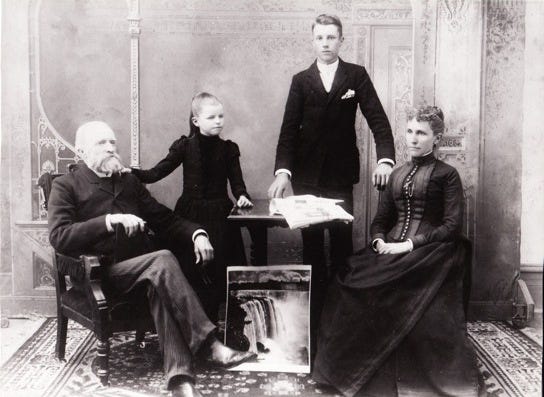
The Iron Age, the hardware industry’s journal of record, took notice that summer — ranking the company among the region’s leading establishments, stocked for the full range of what the Pacific Northwest’s industries demanded.¹⁴ The man who founded it was not mentioned. The institution was. That was, in its way, exactly the point.
The fire didn’t make him. It revealed him.
He had spent thirty years moving — Indiana to California, California to Iowa, Iowa to Nebraska, Nebraska to Oregon, Oregon to Seattle. Each time he left, he left because the next thing was already visible on the horizon. This time was no different, except for one thing: the next thing was here. The city he had watched from canoes on Puget Sound, selling flour to sawmill towns, imagining what it might become — that city was still becoming. He had a bank, a real estate portfolio, and thirty years of hard-won judgment about how the world worked. He was fifty-six years old. For Martin Dickerson Ballard, that was just getting started.
Martin Dickerson Ballard served as Vice President, and later President, of the National Bank of Commerce through the 1890s. He built his mansion at 22 West Highland Drive on Queen Anne Hill beginning in 1900, completing it the following year at a cost of $8,000 to $10,000. He died in Seattle on 26 April 1907 and is buried at Mt. Pleasant Cemetery. The mansion still stands.
Endnotes
¹ The store’s opening date of 2 February 1883 is given by Roy Page Ballard’s 1945 family memoir; Martin’s December 1882 arrival is established by a 1926 retrospective account in the Seattle Post-Intelligencer. A 1926 P-I company history gives the opening date as 8 February 1883, but Roy’s account is the closer primary source and is preferred here. Roy Page Ballard, “The Story of His Family Written by Roy Page Ballard at the Request of His Children,” manuscript, 2 March 1945; transcribed and published online at The Ballard Family (ballardfamily.wordpress.com/about/). “Yesler Garden First Home,” Seattle Post-Intelligencer, 7 November 1926, p. 2C; digital image, Washington Digital Newspapers (washingtondigitalnewspapers.org).
² Roy P. Ballard, the founder’s son, recalled helping hand up the first boxes of hardware to the shelves when the store opened. Roy was nine years old at the time. His account was written in 1945, sixty-two years after the event, at the request of his children. It is family tradition rather than contemporary documentation, but it is the only surviving account of the store’s opening day. Roy Page Ballard, “The Story of His Family Written by Roy Page Ballard at the Request of His Children,” manuscript, 2 March 1945; transcribed and published online at The Ballard Family (ballardfamily.wordpress.com/about/).
³ The Seattle Hardware Company incorporated on 18 March 1885. The primary incorporation papers have not been located; the date is established by multiple contemporaneous sources including the company’s own retrospective account. “Seattle Hardware Co.,” Seattle Post-Intelligencer, 1 January 1895, p. 47; digital image, Washington Digital Newspapers (washingtondigitalnewspapers.org).
⁴ “May Success Follow Them,” Detroit Free Press, 15 April 1890, p. 4; digital image, Newspapers.com (newspapers.com).
⁵ Martin and Harriet Ballard filed the Lake Union Addition plat in early 1884, in partnership with C.P. Stone and I.N. Bigelow. “Lake Union Addition,” Seattle Post-Intelligencer, 13 January 1884, p. 1; digital image, Washington Digital Newspapers (washingtondigitalnewspapers.org).
⁶ Home Fire Insurance Company of Seattle incorporated 9 March 1888. “Home Fire Insurance Company,” San Francisco Chronicle, 10 March 1888, p. 6; digital image, Newspapers.com (newspapers.com). Martin’s name appears alongside Ezra Meeker’s at the July stockholder meeting: “Home Fire Insurance Company Stockholders,” Seattle Post-Intelligencer, 17 July 1888, p. 1; digital image, Washington Digital Newspapers (washingtondigitalnewspapers.org).
⁷ The account of Oliver Meeker’s invitation, the all-night conversation, and the five o’clock decision comes from Roy Page Ballard’s 1945 family memoir, written at the request of his children. Roy was born in 1873 — twenty-one years after the events he describes — and his account represents family tradition as Martin told it to him, not firsthand knowledge. The story is internally consistent and corroborated in its broad outlines by Dennis M. Larsen’s authoritative study of the 1852 trail, which independently documents the Ballard-Meeker Indiana connection. Subsequent research suggests some details reflect the generational compression common in family oral tradition; the primary record places Oliver as Ezra’s older brother, five years Martin’s senior, already organizing an emigrant party when the two men met. Roy Page Ballard, “The Story of His Family Written by Roy Page Ballard at the Request of His Children,” manuscript, 2 March 1945; transcribed and published online at The Ballard Family (ballardfamily.wordpress.com/about/). Dennis M. Larsen, “Ezra Meeker on the Oregon Trail in 1852: the ‘Bottom Facts,’” Overland Journal, Vol. 40, No. 3 (Fall 2022); article shared directly by the author, April 2026. Page numbers not confirmed from pre-publication manuscript.
⁸ “Puyallup,” Tacoma Daily Ledger, 11 June 1890, p. 6; digital image, Newspapers.com by Ancestry (Newspapers.com). The item is a social column report of the reunion, written third-hand; “forty years” is a slight overcount — the trail journey was thirty-eight years earlier. The warmth of the reunion and the public acknowledgment that the two men crossed the plains together are what the source establishes.
⁹ “Bank of Commerce — New Incorporation That is to Do Business in Seattle,” Seattle Post-Intelligencer, 19 April 1889, p. 5; digital image, Washington Digital Newspapers (washingtondigitalnewspapers.org).
¹⁰ “Seattle in Ashes,” St. Louis Globe-Democrat, 8 June 1889, p. 6; digital image, Newspapers.com (newspapers.com).
¹¹ “Seattle Hardware Company Annual Meeting,” Seattle Post-Intelligencer, 8 April 1890, p. 8; digital image, Washington Digital Newspapers (washingtondigitalnewspapers.org).
¹² “National Bank of Commerce,” Seattle Post-Intelligencer, 24 April 1890, p. 8; digital image, Washington Digital Newspapers (washingtondigitalnewspapers.org).
¹³ “Dinner to Employes,” Seattle Post-Intelligencer, 5 March 1891, p. 8; digital image, Washington Digital Newspapers (washingtondigitalnewspapers.org).
¹⁴ “Pacific Coast Hardware Trade,” The Iron Age, Vol. XLVI, No. 5, 31 July 1890, p. 191.
AI Collaboration Disclosure
This article was researched and drafted through an extended iterative AI-human collaboration.
The author — Michael Lee Stills, independent historian and genealogist (Certificate in Genealogical Research, Boston University) — directed all research priorities, contributed substantive written observations and corrections throughout the working sessions, made all interpretive and editorial decisions, and maintained final authority over all conclusions.
Claude (Anthropic, claude-sonnet-4-6) served as research partner and drafting engine. The draft reflects the author’s voice and judgment developed through extended collaborative dialogue across multiple research and drafting sessions. ChatGPT (OpenAI) provided independent editorial review at key stages; suggestions from that review were considered and selectively incorporated during revision.
All primary sources were verified against original document and newspaper images by the author. Source verification is documented in the Seattle Source Registry v2 (April 2026) in the author’s research files. The registry covers thirty-three sources spanning Martin Dickerson Ballard’s Seattle period (1882–1907), including contemporary newspaper coverage, photographic collections from the University of Washington Special Collections, family manuscripts, municipal records, and national trade press.
The Archival Interloper | Michael Lee Stills | April 2026